FRER functional description
Frame Replication and Elimination for Reliability (FRER) is defined in IEEE 802.1CB-2017.
FRER reduces the probability of packet loss by replicating packets at the source, transmit these replicas over multiple paths, and finally removing the duplicate packets at the destination.
A FRER enabled switch consists of the following building blocks:
-
Stream Identification - Identifies the stream based on and fields from the frame.
-
Sequence Generation - Generates a sequence number for each packet in a Member Stream..
-
Stream Split - Split a stream into multiple new Member Streams on different egress ports.
-
Individual Recovery - Discards duplicate frames of a Member Stream.
-
Sequence Recovery - Discards duplicate frames of a merged set of Member Streams.
Streams are transmitted in a separate VLAN, where forwarding is set up manually and flooding and learning is disabled.
Spanning Tree is used to avoid frames looping in other VLANs.
1. FRER Overview
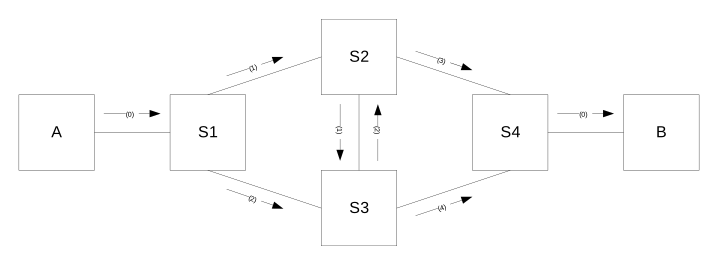
The illustration below shows a stream from host A to host B via switches S1-S4. The stream is assigned to VLAN 10:
-
Host A is FRER-unaware and sends an untagged stream (0) with DMAC = MAC address of host B.
-
Switch S1 does the following FRER functions:
-
Stream Identification: The received frame from host A is identified as belonging to Member Stream 0 and is classified to VLAN 10.
-
Sequence Generation: The sequence number for the frame is assigned.
-
Splitting: The frame is forwarded to two Member Streams (1) and (2) using a C-tag with VID 10 and an R-tag with the sequence number.
-
-
Switch S2 does the following FRER functions:
-
Stream Identification:
-
The received frame from S1 is identified as part of Member Stream 1.
-
The received frame from S3 is identified as part of Member Stream 2.
-
-
Merge: Member Stream 1 and Member Stream 2 map to the same Compound Stream.
-
Sequence Recovery: One of the received frames in the Compound Stream is discarded. The resulting Member Stream 3 is forwarded towards S4.
-
-
Switch S3 operates in a similar way as S2.
-
Switch S4 does the following FRER functions:
-
Stream Identification:
-
The received frame from S2 is identified as part of Member Stream 3.
-
The received frame from S3 is identified as part of Member Stream 4.
-
-
Merge: Member Stream 3 and Member Stream 4 map to the same Compound Stream.
-
Sequence Recovery: One of the received frames in the Compound Stream is discarded. The resulting stream is forwarded towards host B without C-tag and R-tag.
-
The remaining FRER description depends on which switch you are using: